Two glimpses of the International Space Station

Here is a time-lapse sequence including two overhead passes by the International Space Station [ISS].  Both passes begin in the lower-left corner of the frame and end in the upper right.

The first pass occurs between 0:46 and 0:47, and the second pass between 1:05 and 1:07.  The station appears as a streak of light in these 4-second exposures.

The International Space Station [center of green circle] overhead, pass 1, at 7:17 PM on 8 Feb 2013.  Green arrow indicates direction of travel.  Visible in the frame for about 1 second.
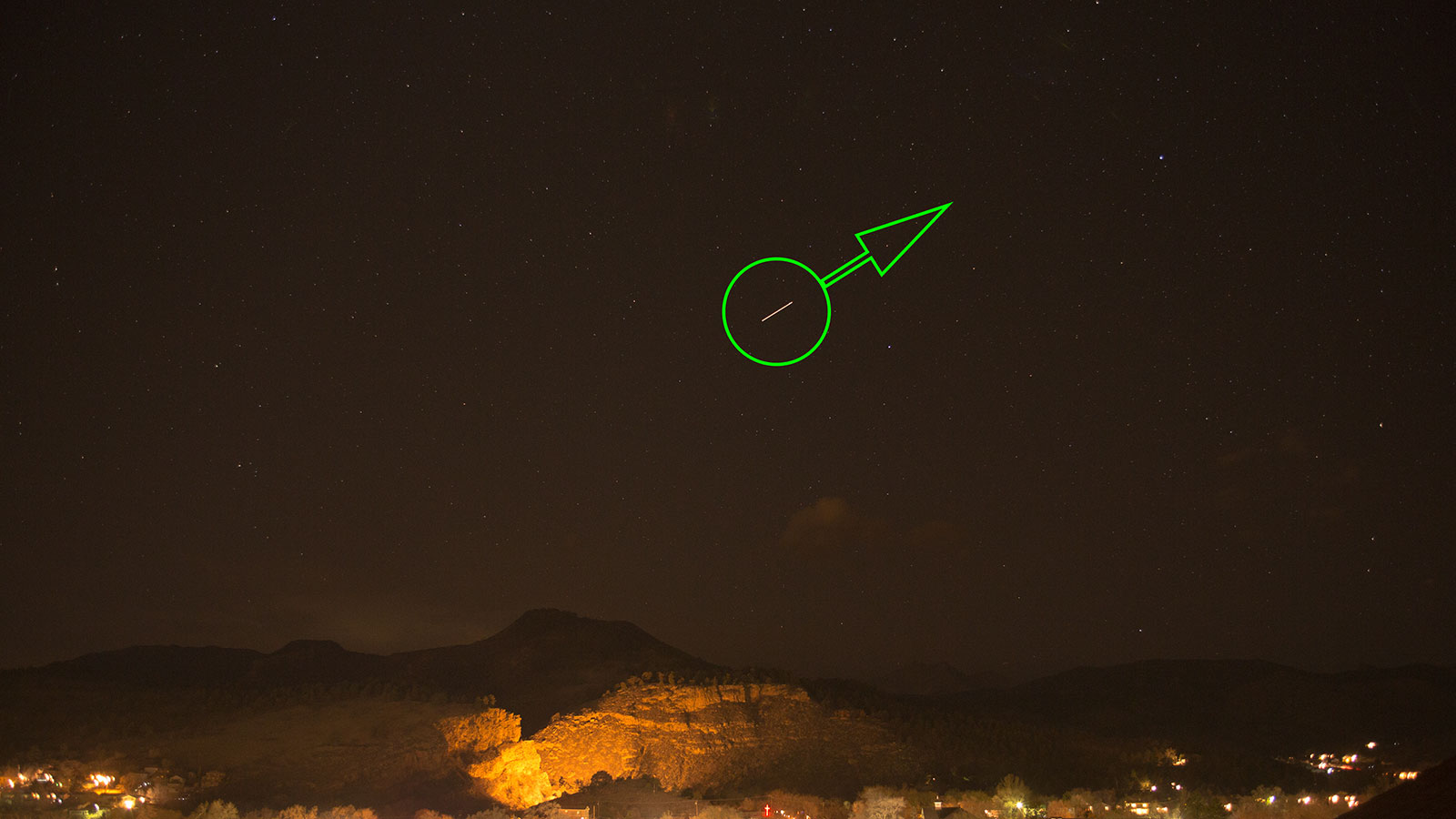
The International Space Station [center of green circle] overhead, pass 1, at 7:17 PM on 8 Feb 2013.  Green arrow indicates direction of travel.  Visible in the frame for about 1 second.

Pass 2, at 8:06 PM on 8 Feb 2013.  Green arrow indicates direction of travel.  Visible in the frame for about 2 seconds.

Pass 2, at 8:06 PM on 8 Feb 2013.  Green arrow indicates direction of travel.  Visible in the frame for about 2 seconds.

The ISS, whose first component, the Zarya module, was launched in 1998, now has approximately a dozen pressurized sections connected and orbiting about 250 miles [402 km] above the surface of the earth [drawing from NASA]:

Major components of the International Space Station [shown as of May 2011].

Major components of the International Space Station [shown as of May 2011].

Shooting star

22 Jan 2012, 5:07 AM MST: A shooting star over Lyons, CO, appears in a single frame of a time-lapse photo sequence.

1304-_P2A-3107.jpg

A close-up is shown below.

1304-_P2A-3107-detail.jpg

There are at least half a dozen shooting stars in the clip below, a time-lapse sequence shot between 3:15 and 7:30 AM.  The one above, the brightest, occurs 44 seconds into the clip.  Smaller ones occur at 00:19 near the center of the frame and at 00:23 in the lower middle part of the frame [these may be hard to see at the resolution displayed here].  In addition, various aircraft and satellites can be observed especially between 00:58 and about 01:12.

Colorado National Monument - May 2011

Colorado National Monument lies just West of Grand Juntion, CO, near the border between Colorado and Utah.

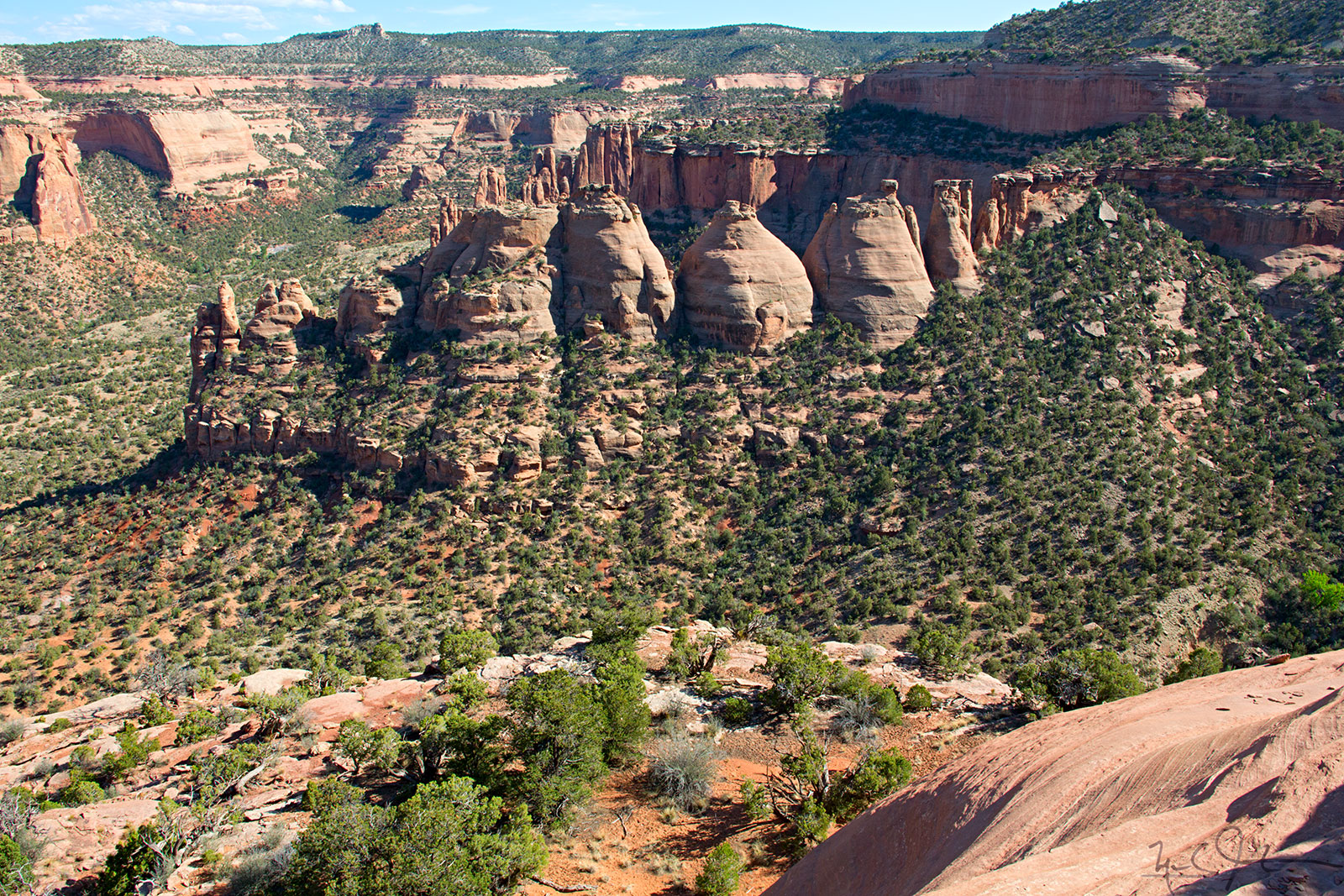
The so-called "Coke Ovens", also known as the "Haystacks".  The stacks are composed of Wingate Sandstone about 200 million years old, with caps composed of harder material called the Kayenta Formation. 

The so-called "Coke Ovens", also known as the "Haystacks".  The stacks are composed of Wingate Sandstone about 200 million years old, with caps composed of harder material called the Kayenta Formation. 

Another view of the Coke Ovens from below in early morning.

Another view of the Coke Ovens from below in early morning.

1221-_P2A-3171.jpg
"Claret cup" cacti in bloom.

"Claret cup" cacti in bloom.

Independence Monument - a 450-foot high fin of Wingate Sandstone with a Kayenta Formation cap is all that is left of a wall that once stretched across the canyon.

Independence Monument - a 450-foot high fin of Wingate Sandstone with a Kayenta Formation cap is all that is left of a wall that once stretched across the canyon.

Collared Lizard, Crotaphytus collaris.  Collared lizards feed mostly on insects, and can run on their hind legs.

Collared Lizard, Crotaphytus collaris.  Collared lizards feed mostly on insects, and can run on their hind legs.

1221-_P2A-3509.jpg